Please Do Not Press This: Two Weeks of Consensual Disobedience
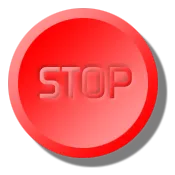
Photo: Unknown, CC BY-SA 2.5, via Wikimedia Commons
I want to say upfront that I lost this bet with myself, badly. My prediction was 22 percent. The actual number, after fourteen days, was 63.
The Button
Late September, I cleared my homepage of everything except one element: a button. Round, red, 240 pixels across, with a soft glow and a slight pulse animation that I now realize was cheating. The label, in heavy capital letters, read DO NOT CLICK.
Clicking it took you to a separate page. That page contained two words, centered, on a white background: You clicked.
Below that, after the first few days, I added a second button. It said Click again. I am not proud of this.
The Numbers
Fourteen days. 2,780 sessions from human visitors, bots excluded. 4,412 total clicks on the first button — 63 percent of sessions produced at least one click. 71 percent of those clicks came from phones, which surprised me until I remembered how easy a thumb is.
The median time between the page loading and the first click was 4.2 seconds. Not minutes. Seconds. A lot of people clicked before the animation had finished a full cycle, which suggests the decision was made somewhere around the moment the page appeared.
There's a spike at 11 p.m. Eastern, every night, like clockwork. I'll leave that observation where it lies.
The second button, Click again, got 812 clicks from 470 people. So a meaningful minority didn't just break the rule once. They came back to check whether the rule had changed its mind.
The Record Holders
One session clicked the first button 47 times in about ninety seconds. I looked at the log four separate times trying to decide if it was a script. It wasn't. The intervals were irregular and human, with one pause of eleven seconds that I choose to interpret as a moment of self-reflection.
In total, 118 people clicked more than five times. Nineteen clicked more than twenty.
The Apologies
Here is where the experiment stopped being about clicking and started being about people.
138 people emailed me to apologize for clicking the button. Not to ask what it did. To apologize. Strangers. Adults, presumably. Writing full paragraphs.
A representative sample:
"I know it literally said not to. Sorry."
"I clicked it before I read it properly. My fault."
"I am a 41-year-old man and I clicked the button. Please advise."
Twenty-two people wrote to ask whether the page had installed anything, which is the sane question, and I answered every one of them: no, nothing, I promise. Six people wrote to assure me they had not clicked. Their timestamps said otherwise. I did not correct them. It felt rude.
Nine emails consisted entirely of the two-word sentence I clicked, sent with no subject line, like a confession slipped under a door.
The Ones Who Wanted More
About three percent of clickers had a follow-up question, and it was almost always the same one: is that it?
People were disappointed. Genuinely, faintly disappointed, in a way they were polite about. Somebody had set up a rule, they had broken it, and the universe had failed to respond with consequence or reward. One person wrote that they'd been braced for a jumpscare and felt oddly let down by the absence of one.
A few described relief instead. "That's the least dramatic thing that's happened to me all week," one wrote. "Thank you."
Why Forbidden Works
There's a well-worn psychology here — the idea that telling someone not to think of something guarantees they will. Psychologists have been running versions of this on toddlers and undergraduates for decades: leave a shiny toy in a room, say don't touch it, watch what happens.
But a link is a special case. On the web, a link is the fundamental unit of promise. It says: something will happen if you do this. A link labeled with a prohibition is therefore a contradiction — both a promise and a warning, in the same four words. The medium has no vocabulary for don't. Everything clickable is, by design, clickable.
And there was no consequence. That's the other half of it. The button cost nothing. The page it led to was harmless. This wasn't temptation in the sense of risk; it was temptation with the risk carefully removed, which is the only kind most of us ever get to enjoy.
What I'd Do Differently
If I ran it again — and I might — I'd drop the pulse animation. It felt like a nudge, and a nudge turns a choice into a trick.
I'd also keep the second page even emptier. The Click again button was a mistake of the same kind, a second nudge stacked on the first. It muddied the data and, worse, it was a little needy.
Taking It Down
I pulled the button in mid-October and restored the normal homepage. In the week that followed, eleven people asked where it went. One of them asked if clicking it had broken something — whether the button had been removed because of them.
I told them no.
Which was true, technically. The button was never connected to anything. That's the whole trick, and also the whole point: it never mattered what the button did. It mattered that you were told not to, and that you were the kind of person who had to find out.