Replying to 2019: What Happened When I Answered Four Years of Ignored Contact Forms, Oldest First
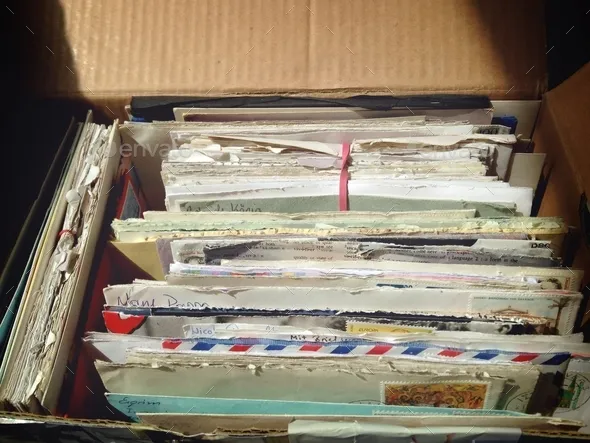
Photo: vintage shoebox full of old unopened letters and envelopes, via s3.envato.com
There's a folder on my site's backend that I have avoided, with real discipline, for years. It's the contact form inbox. Not the current one — that one fills up with the usual spam bots offering SEO services and a genuinely alarming number of messages from people named 'cryptoqueen.' I mean the other inbox. The archive. The place where messages go to sit in the dark like a shoebox of unopened mail.
Somewhere in there, I knew, were messages from actual humans. Real questions, asked in good faith, that I'd never answered because at some point the notification stopped reaching me and I stopped checking. So I did the thing any reasonable person running a small weird website would do: I committed to a month of answering everything, sorted oldest first, and I kept notes.
The Oldest Message Was From 2019
The earliest submission in the archive was dated March 2019. Someone named Dana had written to ask whether the pattern generator on my site ran client-side or server-side, because they wanted to build something similar for a middle school art class in Ohio.
Four years later, I typed back an answer.
I want to be clear about what this felt like. It felt like writing a letter to a stranger across a canyon of time. Dana's message contained references to things — a job, a school year, a version of my own website that barely exists anymore — that had all quietly expired. I answered the question anyway, thoroughly, and then added a postscript explaining the delay, the experiment, and my apology for the gap.
Dana never replied. I didn't expect it. But the site analytics show someone in Ohio visited the pattern generator page the day after I sent it. Make of that what you will.
A Message Is a Photograph of a Moment
Reading old contact forms in chronological order is weirdly like flipping through someone's photo album, except the photos are all of questions people had. And questions age strangely. A person who wrote in 2020 asking 'is this site dead?' was, statistically, having a very specific kind of pandemic afternoon. Someone who wrote in 2021 asking where to buy a print of something I never made prints of was clearly shopping for a gift with a deadline attached — a deadline that has long since passed, gift or no gift.
Every message was a small time capsule with the seal already broken. The person had moved on. The need had expired. But the artifact of the need was still sitting there, glowing faintly in my admin panel, asking to be witnessed.
The Ones Who Wrote Back
Out of forty-one messages, eleven people replied to my very late responses. That ratio surprised me — I'd guessed maybe two.
The replies fell into a few camps:
- The delighted. People who were genuinely tickled to get an answer out of nowhere. One guy wrote, 'I forgot I even had a website I liked.' I've thought about that sentence a lot.
- The confused. A couple of people clearly suspected a phishing scam. Fair. A reply from a website owner saying 'sorry it took me four years' reads, on its face, like a very elaborate con.
- The ones still stuck. Three people were still dealing with the exact problem they'd written about. Their question hadn't expired at all — it had just been waiting. Answering those felt less like archaeology and more like showing up late to help someone move, but still in time to carry a couch.
That last group changed the shape of the experiment for me. I went in thinking of the backlog as a graveyard. It turned out some of it was a waiting room.
What I Learned About Delayed Correspondence
Answering an email the day it arrives is a transaction. Answering it years later is something closer to a gesture. The response no longer solves a problem in real time, so it becomes purely a signal: you were heard, eventually, and someone cared enough to close the loop.
There's a real intimacy in that, oddly more than in prompt replies. Nobody expects an answer from the past. When one shows up, it feels less like customer service and more like a message in a bottle washing back up the wrong way.
I also learned that my contact form has been quietly broken since roughly 2022, which explains a lot, and that at least two of the 'people' in the archive were bots with surprisingly poignant copy. One asked, repeatedly, 'are you there?' in a way I chose not to answer.
Should You Answer Your Own Backlog?
If you run any kind of site — a blog, a portfolio, a digital playground with no map — you probably have a version of this folder. My recommendation, based on one month of rigorous research with a sample size of one: do it. Sort oldest first. Answer even the ones that feel too late. Especially the ones that feel too late.
The internet already loses enough messages to entropy. Closing a loop four years late beats leaving it open forever. And if nothing else, you'll finally learn what's been sitting in your own attic.
Dana, if you're out there: it runs client-side. Sorry about the wait.